The product-specific rule depends on the HS code, so classify first. Then check the rule for that heading, keep the evidence (bill of materials, supplier declarations, costings) and write the code you used on the statement.
The statement on origin
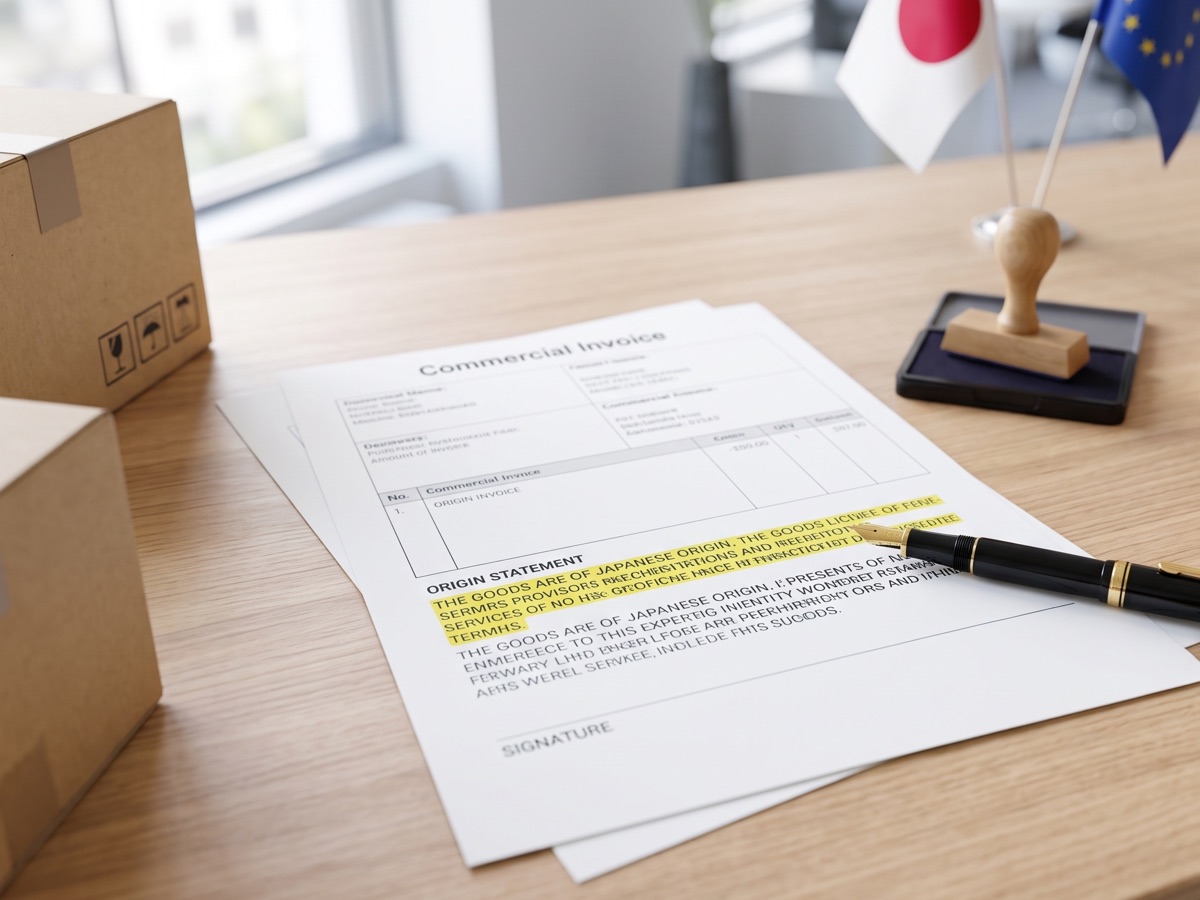
The exporter writes this text on the invoice or another commercial document:
The exporter of the products covered by this document (Exporter Reference No ...) declares that, except where otherwise clearly indicated, these products are of Japan preferential origin. (Origin criteria used ...)
Point
Rule
Exporter Reference No
The 13-digit Japan Corporate Number (法人番号); can be left blank if none
Validity
12 months from the date it is made out
Multiple shipments
One statement can cover identical products for a stated period of up to 12 months
Records
The exporter keeps a copy and the origin evidence for at least four years
The EU importer can also claim the preference on its own knowledge that the product originates, without a statement from the exporter. It then needs the evidence itself, which is practical mainly for related companies. JJapan Customs
Illustration: an Osaka tableware maker invoices a German importer for 500 Japanese-made porcelain bowls.
Invoice field
Entry
Exporter
Company name, Osaka address
Goods
500 porcelain bowls, HS 6911.10
Statement on origin
The exporter of the products covered by this document (Exporter Reference No 1234567890123) declares that, except where otherwise clearly indicated, these products are of Japan preferential origin. (Origin criteria used: A)
Place and date
Osaka, 19 November 2026
Criterion A suits goods wholly obtained in Japan; bowls fired from imported clay would usually use C instead. The Corporate Number shown is a placeholder. European Commission
Who keeps what
Party
Keeps
For
Exporter
Copy of the statement and origin evidence
At least 4 years
Importer
The statement, or its own evidence when using importer's knowledge
Razvan Toma is the founder of EPR EU Rep, the group behind EPR France Rep, EPR Germany Rep and EPR Spain Rep, authorised representatives for producers with no establishment in those countries. He has worked in waste management and recycling since 2009, running circular economy programmes inside large B2B organisations in France for clients including Chanel, Microsoft, Decathlon, Pirelli, IKEA, Vinci, Capgemini and E.Leclerc.
 By Razvan Toma · Founder